Flat Plane Vs Cross Plane V8 engines
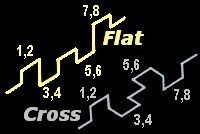
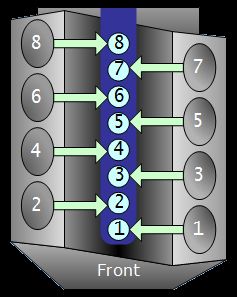
Like all high performance and race V8s
(e.g. Cosworth DFV, Coventry Climax, Ferrari F40, TVR
Cerbera AJP V8), the Lotus type 918 V8 uses a flat plane
crankshaft configuration - as the name suggests,
all the cranks pins are in the same plane, unlike the cross
plane V8 crank, where 2 of the crank pins are set at 90% to the
other 2 (nearly all V8s use a 90% V between each bank of
cylinders and a piston/rod in one bank shares a crank pin with a
piston/rod in the opposite bank)
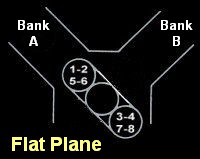

A flat plane V8 (animated on the left)
is very much like two inline-4 engines mated together in a V
configuration - So end-to-end balance is inherent, as the first
and last piston of a bank is always exactly in the same
position, as are the center two pistons on each bank
Now, the exhaust note of an engine is related to the manifold
design, which is related to the firing order, which is related
to the cylinder layout and crankshaft design - therefore the sound of flat-plane V8 is
usually somewhat like a pair of four-pot engines screaming
simultaneously, unlike the rumble of cross-plane V8s
There have been comments like "It doesn't sound
like a V8" aimed at the V8 Esprit... but this should really be
"It sounds like a Racing V8!" for the
reasons explained here
While it may be true that flatplane V8s are less refined than crossplane (the flat-plane crank pins produce vibrations, being 180° opposed and thus lacking rotational balance, unless balance shafts are used - which is actually rare), refinement is not a priority for sports/race cars and light weight pistons and conrods and a short stroke "over square" configuration greatly reduce this "second-order vibration" - More importantly, as a flatplane crankshaft does not require counterweights, it has less mass and a lower moment of inertia, providing higher rpm and more rapid acceleration
The firing order with a flatplane V8 allows for perfect balance between banks - each subsequent firing cylinder being on alternating left and right banks - there are a number of possible firing orders for a flat plane crank e.g. 1-6-3-2-7-4-5-8 or 1-4-5-2-7-6-3-8 but all follow a R-L-R-L-R-L-R-L bank pattern
This produces even exhaust gas pressure pulses
from each bank - allowing manifold design to be fairly simple,
with good scavenging and no need for cross over piping
from side to side
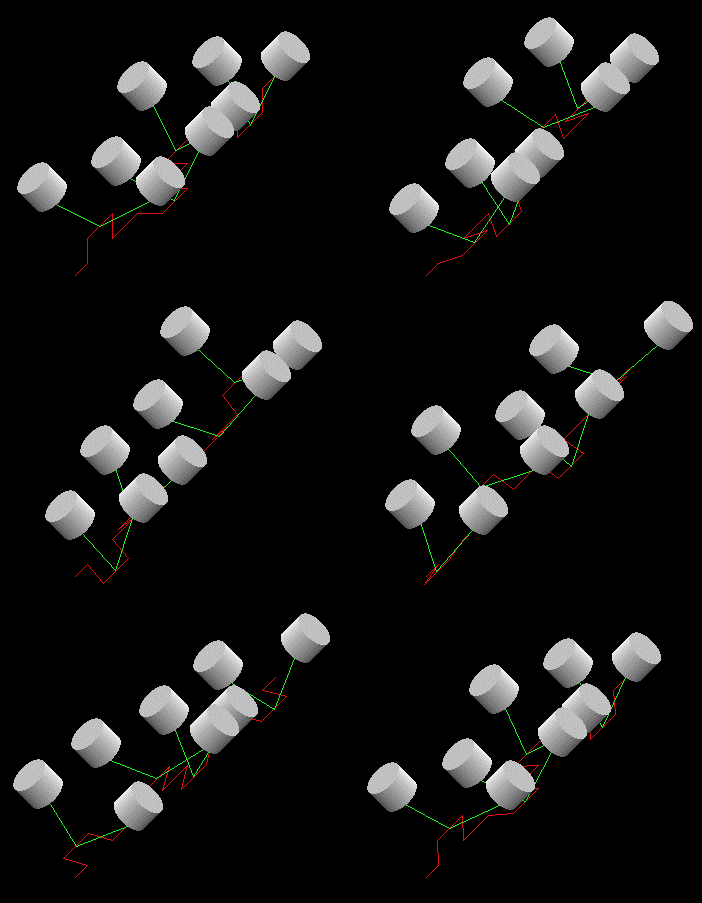 A cross plane V8 (animated on
the right) is the configuration commonly used in American
road cars, plus the Rover V8 (originally General Motors/ Buick/
Oldsmobile), of course, with the crank pins set at 90°,
180°, 90° to the preceding pin(appearing in the form of a cross
from crankshaft end) - the cross-plane design can achieve
very good balance but requires heavy counterweights on the
crankshaft to achieve it
A cross plane V8 (animated on
the right) is the configuration commonly used in American
road cars, plus the Rover V8 (originally General Motors/ Buick/
Oldsmobile), of course, with the crank pins set at 90°,
180°, 90° to the preceding pin(appearing in the form of a cross
from crankshaft end) - the cross-plane design can achieve
very good balance but requires heavy counterweights on the
crankshaft to achieve it
It therefore has the
major inherent disadvantages of larger crankshaft mass and
higher rotational inertia - making it less responsive and
lower revving - the larger crankcase needed to accommodate
the counter weights also makes the engine taller and raises
it's centre of gravity, which adversely affects car handling
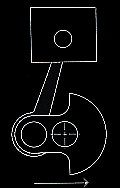
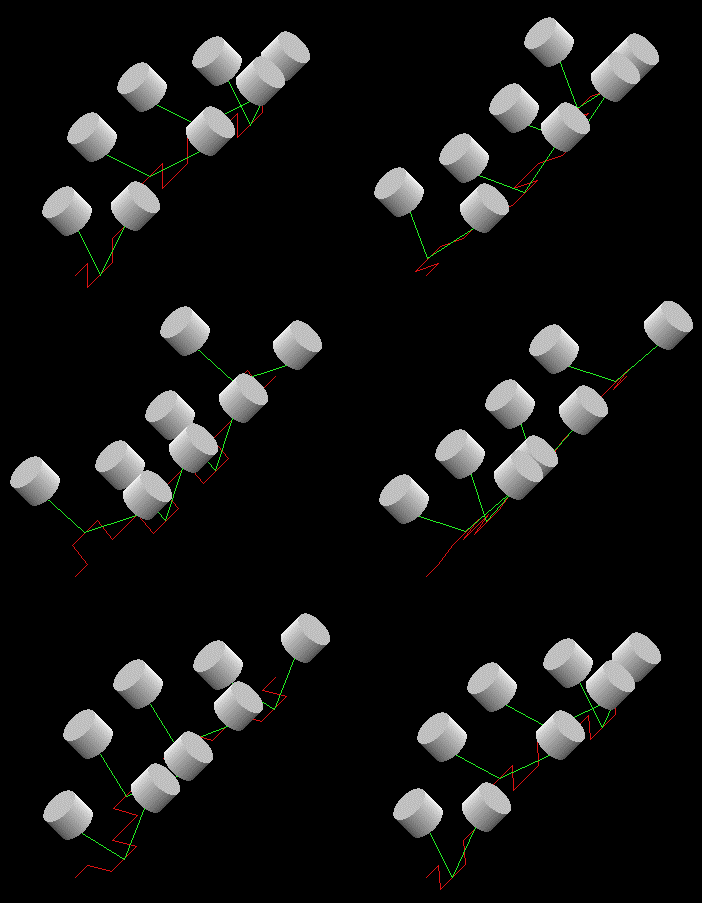
Heavy counter weights are used with cross plane
cranks - normally (on non V8 configurations) counter weights
with sufficient mass to balance the crank throw, con-rod and
pistons cause further imbalance with rotation - as the diagram
on the left shows, when the counter weight has rotated to
the right, the piston and con-rod do not move left as far as the
crank pin
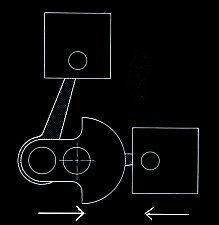
However, as shown on the right, with a 90° V8 the piston from
the opposite bank will contribute to balancing the counter
weight entirely, endowing the cross-plane V8 with near perfect
smoothness, albeit at the expense of compactness, revvability
and the exhaust shortcomings below
The crossplane V8 crank makes firing order and
exhaust design more problematic - the way the crank pins
bring the pistons to TDC dictates that firing a cylinder on the
same side as the previous cylinder must happen at least twice
(once on the left bank and once on the right bank) - in fact
this includes 2 adjacent cylinders on one bank, which is far
from ideal in terms of mechanical stress and heat soak (again
there are a number of possible firing orders - but some are
never used in practise as they have all 4 cylinders in a bank
firing sequentially!
For
a cross plane V8, the four usable firing orders are
1-8-4-3-6-5-7-2, 1-8-7-3-6-5-4-2, 1-8-7-2-6-5-4-3 and
1-5-4-3-6-8-7-2
Giving bank patterns of
R-L-L-R-L-R-R-L, R-L-R-R-L-R-L-L,
R-L-R-L-L-R-L-R and R-R-L-R-L-L-R-L
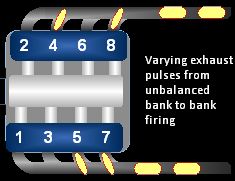
This firing order anomaly is what creates the typical American V8 burble (so it's a sign of inefficiency!) - when two cylinders fire sequentially on the same bank, the two exhaust pulses combine to form a higher pressure and associated note from the tailpipe, which alternates from side to side
Exhaust manifold design is not easy with the
cross plane crank - cross over piping from side to side is
required to improve scavenging - making this configuration
unsuitable for racing/single seater applications. For
road applications, balance pipes are often used to equalise side
to side exhaust pressure, which helps scavenging somewhat at low
RPM